Learning Neural Lyapunov Functions on SO(n)
A physics-informed neural framework that learns maximal Lyapunov functions — and estimates regions of attraction — for dynamical systems evolving on the rotation group SO(n).
Proving stability for systems on Lie groups is hard: the classical Lyapunov machinery built for Euclidean space does not transfer to curved geometries. This project learns maximal Lyapunov functions for systems evolving on the special orthogonal group SO(n) — certificates that both prove stability and estimate the largest possible region of attraction.
We introduce a neural Lyapunov architecture based on the logarithmic map, with proven approximation capabilities, and cast learning as a Zubov-type characterization of the maximal region of attraction. A central technical contribution is an explicit, numerically tractable formula for the derivative of the logarithmic map, which enables a two-phase training algorithm that trades off computational cost against accuracy.
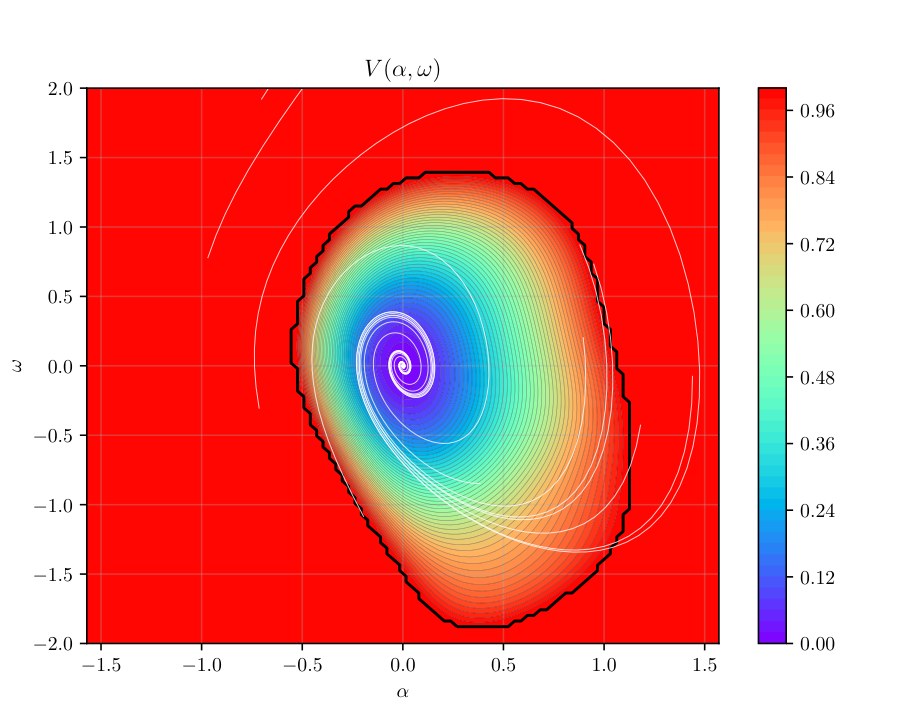
A learned Lyapunov function V(α, ω): the black contour is the estimated region of attraction; white curves are trajectories spiraling into the stable equilibrium.
Contributions
- A neural Lyapunov architecture on SO(n) built from the logarithmic map, with approximation guarantees.
- Explicit, tractable formulas for the derivative of the log map that make training feasible.
- A two-phase learning algorithm validated on an interpretable low-dimensional nonlinear system, recovering a large region of attraction.
Learning Neural Maximal Lyapunov Functions on SO(n) — Adeel Akhtar, Matthieu Barreau (IEEE Control Systems Letters).