Numerical comparison of the Schrödinger bridge on the torus
$\mathbb{T}^{2}\cong\mathsf{SO}(2)\times\mathsf{SO}(2)$, connecting prescribed endpoint probability distributions using the stochastic optimal-control and path-space formulations.
Abstract
We establish the equivalence between the stochastic optimal control and path space formulations of the Schrödinger bridge problem (SBP) for the kinematic equation on a compact connected Lie group. Using the geometric concepts of horizontal lift and stochastic anti-development, we derive a Girsanov-type change-of-measure result, and show that the expected control energy equals the relative entropy of the controlled path law with respect to the reference Wiener measure. Thus, the SBP is equivalently a path space relative entropy minimization problem subject to prescribed endpoint marginals.
Our result has three useful implications. From an analytic viewpoint, the shown equivalence helps prove the existence and uniqueness of the SB. From a probabilistic viewpoint, it helps interpret the SB as the most probable deviation of the uncontrolled stochastic dynamics consistent with the endpoint constraints. From a computational viewpoint, it allows using static Sinkhorn recursions to directly solve the relative entropy minimization problem and compute the optimal path measure. We illustrate the equivalence numerically on the torus $\mathbb{T}^2$. The code is publicly available in the project repository.
Main Contributions
The central result is the equivalence between the stochastic optimal-control and path-space formulations of the Schrödinger bridge problem on compact connected Lie groups. The paper develops this equivalence intrinsically, without reducing the dynamics to a fixed Euclidean state space.
Geometric change of measure
A Girsanov-type result is derived using horizontal lift and stochastic anti-development, which represent the Lie-group diffusion in Euclidean coordinates while respecting the intrinsic geometry.
Control energy = path-space entropy
The expected control energy is shown to equal, up to the diffusion scaling, the relative entropy of the controlled path law with respect to the reference Wiener measure.
Analytic, probabilistic, and computational consequences
The equivalence yields an existence-uniqueness result, a large-deviation interpretation of the optimal bridge, and a static Sinkhorn formulation for computing the optimal path measure.
Numerical Results
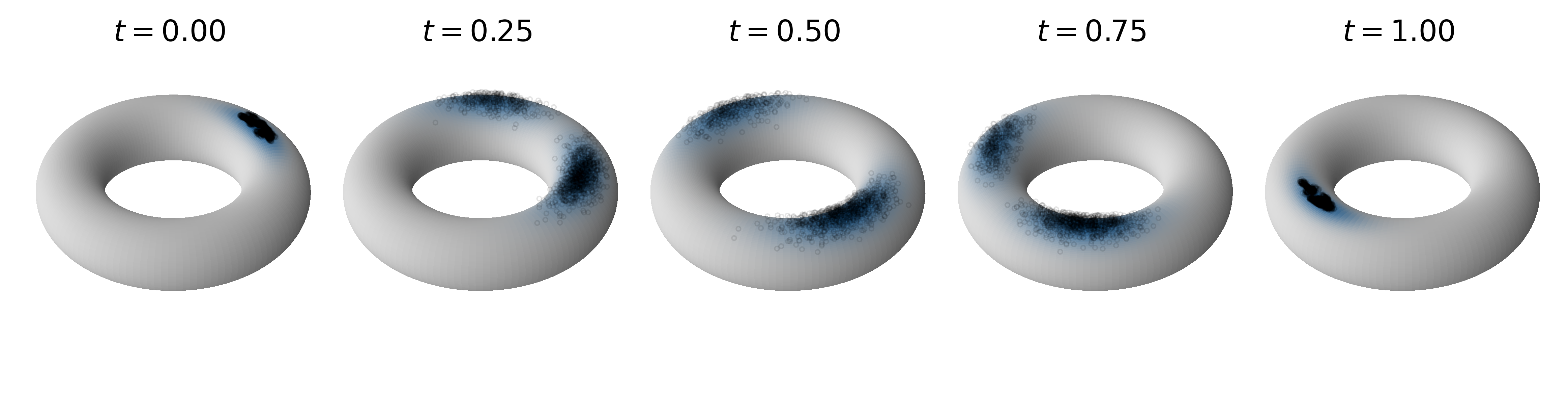
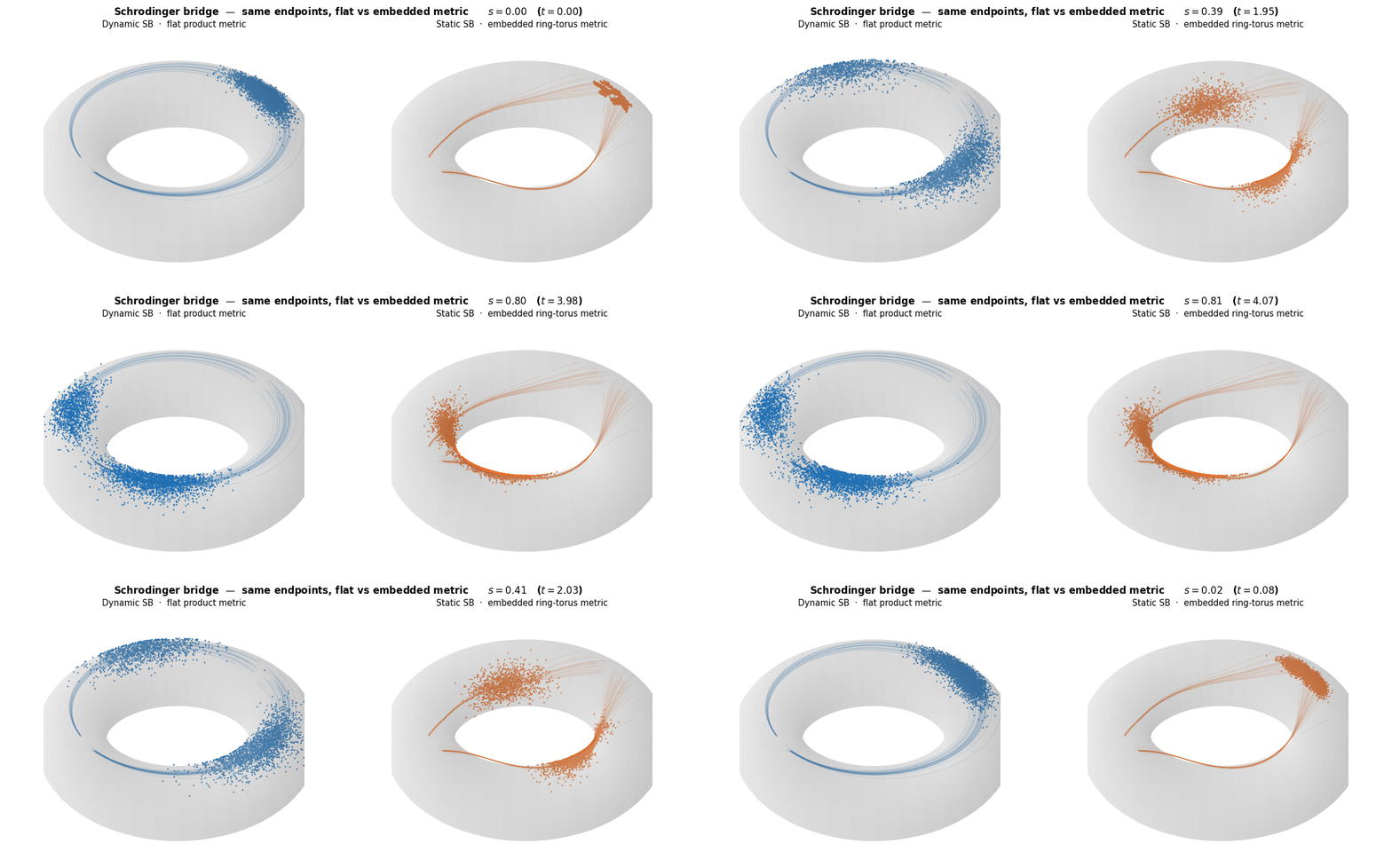
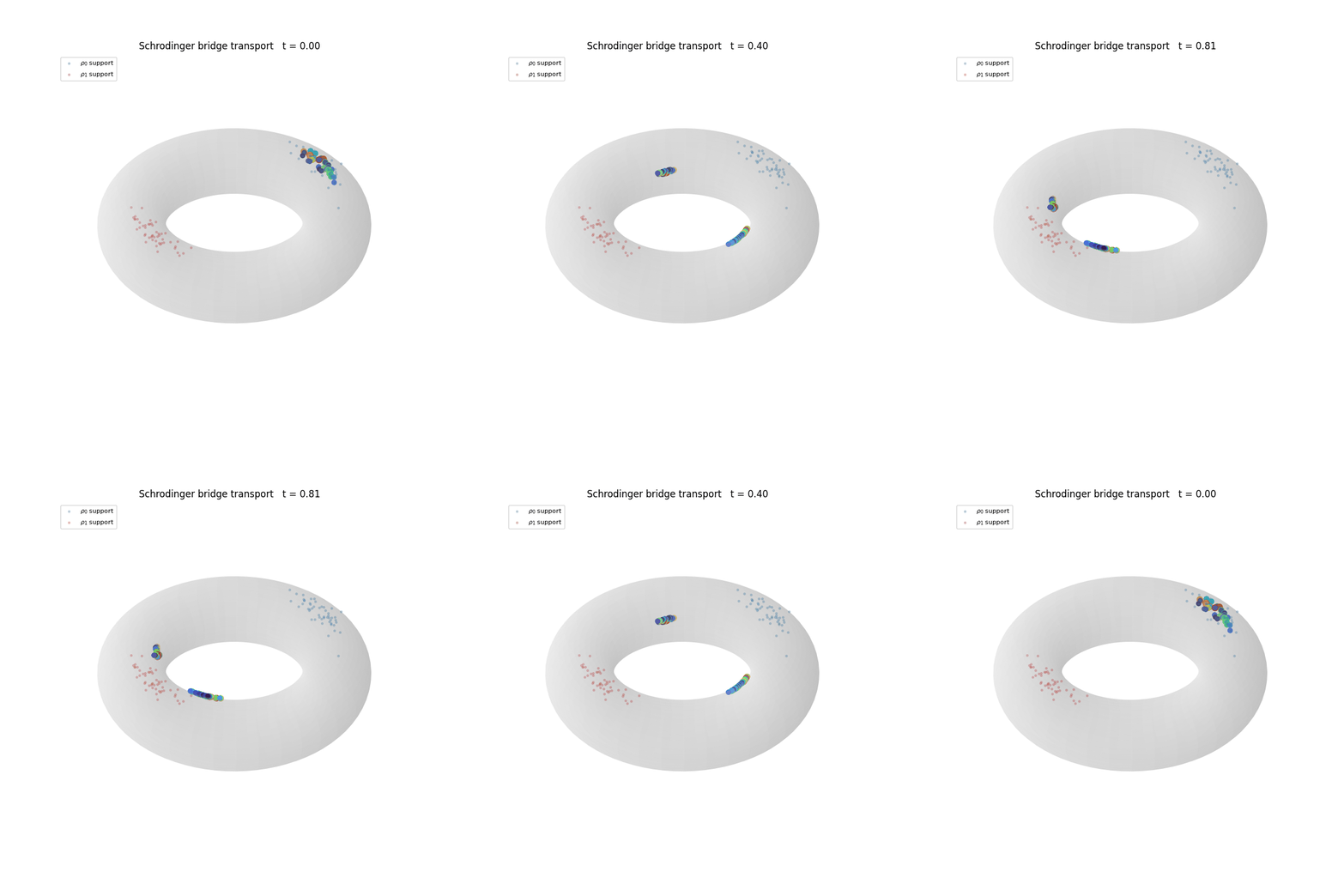
We illustrate the equivalence on the torus $\mathbb{T}^{2}$. For the stochastic optimal-control formulation, the endpoint densities are discretized on a $128\times128$ grid and the associated Schrödinger system is solved using dynamic Sinkhorn recursions. For the path-space relative-entropy formulation, $N=50$ points are sampled from the discretized endpoint distributions and the corresponding problem is solved using static Sinkhorn recursions.
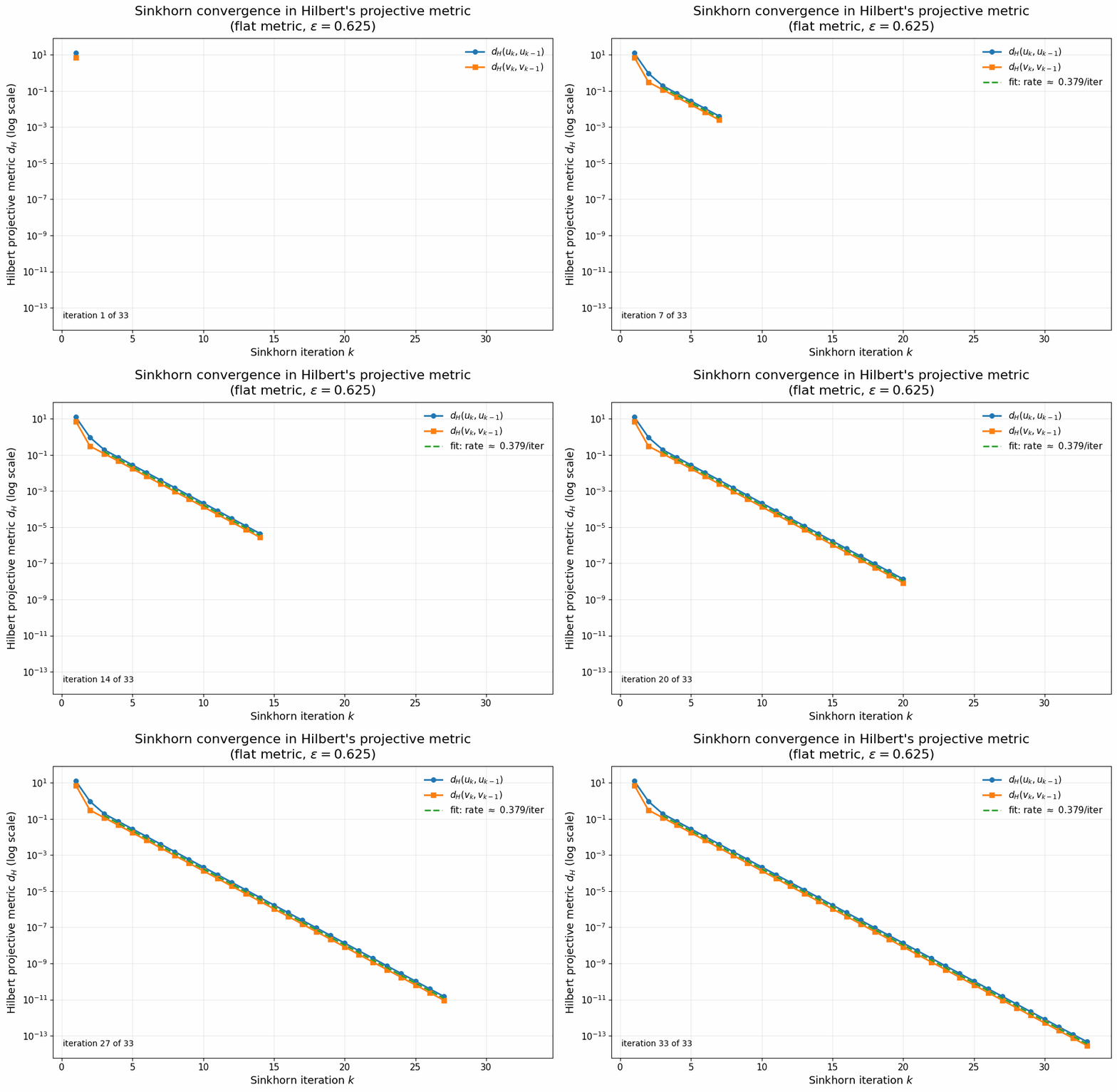
The first two animations compare the resulting bridge evolutions. The additional animated convergence plot shows the behavior of the static Sinkhorn iterates in Hilbert's projective metric.
Stochastic optimal-control formulation
Evolution of the optimal probability density $\rho^{\mathrm{opt}}_{\sigma}(\cdot,t)$ obtained from the continuous-density formulation by solving the boundary-coupled Schrödinger system with dynamic Sinkhorn recursions.
Path-space relative-entropy formulation
Sample-based visualization of the optimal path measure $\mathbb{P}^{\mathrm{opt}}$ computed using static Sinkhorn recursions. The transported samples follow the same bridge evolution as the continuous-density solution.
Static Sinkhorn convergence in Hilbert's projective metric
Successive distances $d_H(u_k,u_{k-1})$ and $d_H(v_k,v_{k-1})$ decay geometrically after the initial transient. For the displayed run ($\varepsilon=0.625$), the fitted contraction factor is approximately $0.379$ per iteration, and the recorded iterates reach the $10^{-13}$ tolerance at iteration 33. This numerically illustrates the linear convergence of the static Sinkhorn recursion used to compute the path-space minimizer.
Code and Reproducibility
Source code and reproducibility material for the numerical experiments are publicly available in the project repository:
gradslab/LargeDeviationSBP.
The repository contains the scripts and numerical assets used to generate the continuous-density and path-space comparisons, the Sinkhorn convergence diagnostics, and the figures and animations shown on this page. See the repository README for the experiment workflow and entry points.
Repository status
Research code, numerical results, and project-page assets are publicly available.
BibTeX
@misc{mahmood2026equivalence,
  title        = {On the Equivalence of Stochastic Control and Path Space Formulations for Schrödinger Bridges over Compact Connected Lie Groups},
  author       = {Hamza Mahmood and Georgiy A. Bondar and Abhishek Halder and Adeel Akhtar},
  year         = {2026},
  howpublished = {GitHub repository},
  note         = {\url{https://github.com/gradslab/LargeDeviationSBP}}
}